
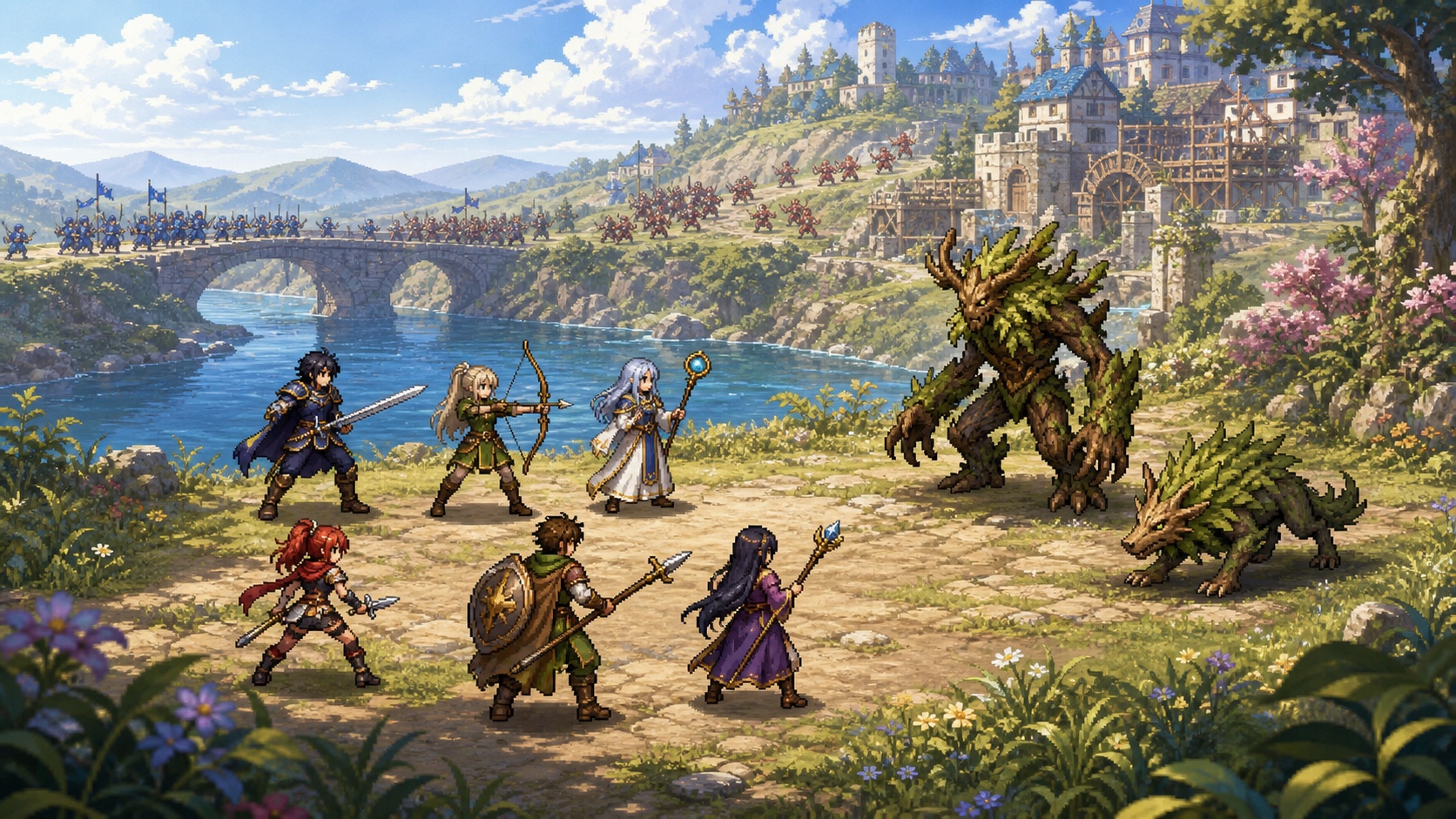
Battle, build, recruit, repeat

Suikoden Star Leap Gameplay Guide

Learn the documented combat and village loops first, then adapt them to the live version instead of following invented level targets.

Quick answer

Suikoden STAR LEAP uses timeline-based, turn-based party battles alongside a separate real-time War Mode. A normal party holds up to six characters across front and back rows. Outside combat, progress comes from training, Bounty Hunts, village reconstruction, facilities, gathering minigames, exploration, resident requests, and finding 108 allies.

Timeline battles and six-character formations

Normal Battles show upcoming actions on a timeline and let characters act in sequence. This differs from older Suikoden rounds where the player selected the whole party at once. Read the next few turns before choosing. A faster option may let an ally act before an enemy, while a stronger choice may be worth waiting for when the party is safe.

Parties support up to six active characters total across front and back rows. Formation therefore matters alongside raw power. Use the live range and role information when positioning each recruit, and recheck rows after changing members. KONAMI has not published one universal formation that fits every encounter.

Normal attacks, Runes, and Special Techniques

The official English battle page names three core actions. Timing, target, and the next timeline position decide which one fits the moment.

01

Preserve tempo

The basic command is generally the quickest route to another action according to developer interviews. It can be valuable when turn timing matters more than a larger immediate effect.

  • Check target and range
  • Compare the next turn position
  • Do not dismiss the basic action

02

Use effect and timing together

Runes provide different abilities and timing. Do not assume every character equips, changes, or uses Runes in the same way. Read the live skill description before building a plan.

  • Different effects
  • Different action timing
  • Character rules may vary

03

Attack, heal, or support

Special Techniques are character-specific actions that can deal damage, restore allies, or provide support. The training system confirms that techniques can be strengthened.

  • Character-specific
  • Multiple combat functions
  • Upgradeable through training

04

A reported four-character command

Famitsu reports that four or more aligned allies can trigger linked consecutive actions with increasing bonus damage. The official English page does not give a localized name or detailed rule set, so verify this command in the current client.

  • Interview-reported rule
  • English name not final
  • Balance may change by version

War Mode is a separate battle layer

War Mode is not the normal turn sequence placed on a larger map. KONAMI describes it as real-time strategy where friendly and enemy units move simultaneously. The player monitors the wider field and commands troops as the situation changes.

Timeline order, Rune timing, and row placement belong to normal combat. Unit movement and battlefield awareness belong to War Mode. Learn each interface separately rather than building a normal party around assumptions about army battles.

Training, Bounty Hunts, potch, and the village

The Bounty Hunt board offers posted monster objectives and awards EXP, training materials, and potch. Training lets characters learn skills and may unlock abilities. Special Techniques can deal damage, heal, or support and can also be enhanced. Begin with the group you actually use instead of spreading early materials across every revealed character.

The village grows as allies gather, opening facilities and functions. Chloe's Item Shop sells materials and consumables for potch, with stock refreshed daily. Yua's kitchen turns minigame ingredients into group meals that deepen bonds and can unlock skills.

Return after major story or recruitment progress, inspect construction changes, check the shop, use relevant ingredients, and then plan the next expedition. Recruitment and base development reinforce one another.

Fishing, harvesting, mining, and exploration

Fishing is available at headquarters and town fishing spots, with catches recorded in an encyclopedia. Vegetable Harvest asks players to distinguish crop-damaging moles from Great Tree Spirits. Mining is a time-limited cooperative activity that provides minerals used for weapon and armor enhancement.

Cities and the overworld hold treasure, items, and unexpected discoveries. Allies can be found through story progress and exploration, so reaching 108 companions requires attention beyond the direct plot route.

Residents also offer Helping Hands requests such as collecting items or defeating monsters. These are optional activities. The official page does not say that Helping Hands directly recruit Stars, so treat rewards and recruitment as separate unless a character condition states otherwise.

A beginner route with no wasted assumptions

This route avoids invented level targets, upgrade quotas, and spending rules. Adjust it when the live client introduces a tutorial, event, or regional balance change.

  1. 01

    Follow the opening story

    Let party, training, and village functions unlock naturally before optimizing systems you cannot yet use.

  2. 02

    Build one dependable group

    Raise a focused party of up to six characters before investing across the entire public roster.

  3. 03

    Watch every timeline

    Compare the immediate effect of a command with where it places that character next.

  4. 04

    Keep formation deliberate

    Recheck front and back rows whenever a party member or encounter changes.

  5. 05

    Use Bounty Hunts when growth stalls

    Earn defined EXP, material, and potch rewards instead of guessing a required grind.

  6. 06

    Return to the village

    Look for construction changes, daily shop stock, meals, and newly available functions.

  7. 07

    Gather with a purpose

    Fish for the encyclopedia, harvest ingredients, and mine when equipment growth is the next need.

  8. 08

    Explore useful side routes

    Check for items, allies, and convenient Helping Hands without assuming every request recruits a Star.

Last verified: August 10, 2026

Sources and checks

  1. Official battle systemOfficial
  2. Official training systemOfficial
  3. Official base systemOfficial
  4. Official minigame systemOfficial
  5. Official exploration and recruitment systemOfficial
  6. Famitsu battle-system interviewInterview

108 questions, one fact at a time

Frequently asked questions

01Is combat fully real time?

No. Normal Battles are timeline-based and turn-based. War Mode is the real-time strategy component.

02How many characters are in a normal party?

KONAMI says up to six characters total can be arranged across front and back rows.

03Which command should I use first?

There is no universal best action. Check its effect, target, and next timeline position. Normal attacks preserve tempo, while Runes and Techniques may provide needed damage, healing, or support.

04Are coordinated attacks confirmed in English?

Famitsu reported a four-or-more timeline condition from a developer interview. The official English page does not yet explain its localized name or complete rules, so the feature remains clearly attributed.

05How do I recruit all 108 allies?

Advance the main story and explore the overworld. Some characters have individual conditions that should be checked one by one rather than guessed.

06What are Helping Hands?

They are optional requests from residents, such as gathering items or defeating monsters. Complete them when their objectives fit your current route.